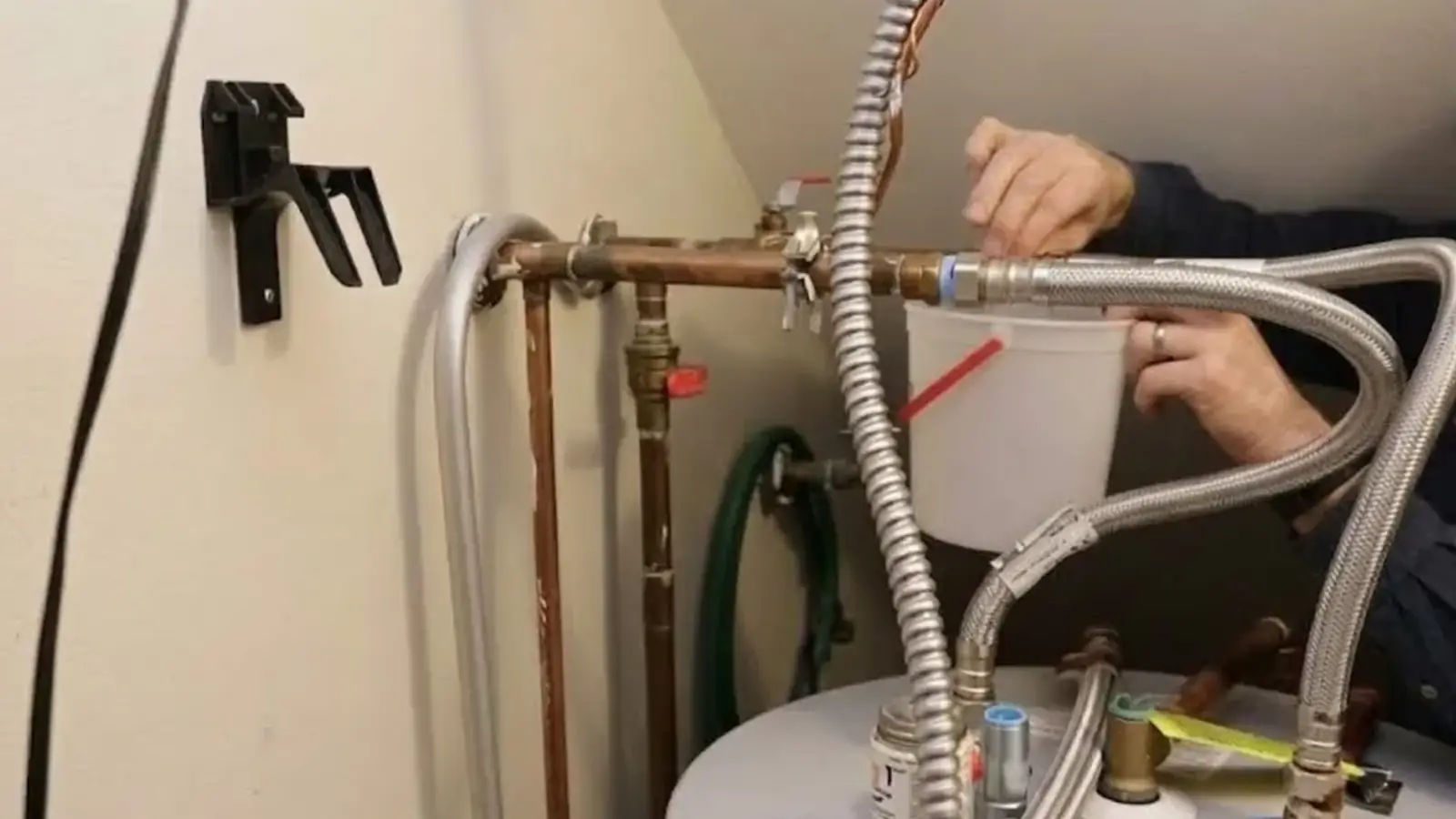
Most water heater calls fall into a handful of causes. Gas heaters lose their flame, electric heaters lose an element or thermostat, and any tank can leak at a fitting or through the tank itself. Many repairs can be finished in a single visit.
The first job is deciding whether the unit is worth repairing. A heater with a failed thermostat or element is a straightforward fix. A tank that is leaking from its shell is finished.
Symptoms and likely causes
| What you notice | Gas heater | Electric heater |
|---|---|---|
| No hot water at all | Pilot out, thermocouple or gas control fault | Tripped breaker, failed upper element or thermostat |
| Lukewarm water | Dirty burner or weak flame | Lower element failed |
| Rumbling or popping | Sediment on tank bottom | Sediment on tank bottom |
| Water pooling underneath | Fitting leak or tank failure | Fitting leak or tank failure |
Hard water and your heater
Cleveland Water draws from Lake Erie, and its 2025 water quality report lists hardness (as calcium carbonate) between 105 and 130, averaging 117. Moderately hard water leaves mineral scale in water heaters over time. Scale insulates the bottom of a gas tank and coats electric elements until they burn out.
A yearly flush removes sediment before it hardens, and an anode rod check shows how the tank is protected from rust. Both are cheap compared with replacing a tank that failed early. We cover this in water heater replacement when a unit is past repair.
Repair or replace
The tank is dry, the unit is not old, and the fault is a part such as an element, thermostat, thermocouple, valve or burner.
The tank leaks from the shell, rust shows at the seams or repairs keep recurring. Water will not stop coming out of a failed tank.
You are replacing anyway and want continuous hot water. See tankless water heaters for the trade-offs.
Water heater leaking: emergency steps
Shut off the cold water to the heater, switch the electric breaker off or turn the gas control to pilot or off, and open a hot tap in the house to relieve pressure. Keep the floor around the unit clear.
Call (440) 468-0237. Dispatch answers 24/7, and a same-day visit is offered when the schedule allows.
Call (440) 468-0237 nowA heater that is hot to the touch near the relief valve, or a relief valve that is dripping, should be looked at promptly. Do not plug the valve.
Safety steps we take on every visit
Any water heater visit includes a look at the temperature and pressure relief valve and its discharge pipe, the venting on gas units and the condition of the connections. A gas unit also gets a check for gas smell and proper burner flame.
If we find something unsafe, such as a blocked vent or a corroded gas connector, we tell you plainly. It may be a small repair or a reason to retire the unit. Either way you decide with the facts in front of you.
No hot water in the house? Call and we will start with the likeliest cause.
Call (440) 468-0237Sources
Hardness and pH figures are quoted from Cleveland Water's published report. Test your own tap for the figure at your fixtures.
Frequently asked questions
Sediment settles at the bottom of the tank and traps steam bubbles under it. A flush often quiets it, and a heavily scaled tank may be near the end of its life.
Yes. Dispatch answers 24/7. A leaking tank or a heater without hot water in cold weather is treated as urgent, and you get shutoff steps right away.
The tank's label has the lighting steps. If the pilot will not stay lit after a couple of tries, the thermocouple or gas valve is usually at fault and it is time to call.
The immediate risks are water damage and, for electric units, shock if the leak reaches wiring. Turn off power and water to the unit and call.