People ask what a softener costs before they ask whether they need one. A better order is to test the water first, decide what problem you are solving and then price the equipment that fits. A softener that is too small runs out. One that is too big wastes salt and water.
This guide lists what moves the price, so that you can compare quotes sensibly. It does not give dollar figures, because they vary with the unit and the house, and a figure printed here would be out of date by the time you read it.
What changes the price
| Factor | Why it matters | What to ask |
|---|---|---|
| Unit size | Capacity is set by household use and hardness | What grain capacity and why? |
| Type | Salt-based, dual-tank or salt-free systems differ | What does it treat and what does it leave? |
| Plumbing layout | Distance to the drain and the water heater changes the pipe work | Where will it go and how much pipe is needed? |
| Bypass and shutoffs | Needed for service and testing | Is a bypass valve included? |
| Electrical outlet and drain | Softeners need power and a drain for regeneration | Is there an outlet and a drain nearby? |
| Pre-filtration | A sediment filter protects the softener in some homes | Is one recommended? |
Test the water first
Hardness test kits are inexpensive, and a result tells you how hard the water is at your tap. Write the number down and note the units, because grains per gallon and milligrams per liter are different scales. A professional lab test goes further and can look at iron, which affects how a softener should be set.
Also check what your problem is. Spots on glasses, scale on fixtures and a heater that makes noise are classic hardness signs. Chlorine taste and odor are not hardness problems, and a softener will not fix them.
Westlake notes: what the utility reports
Cleveland Water's 2025 report lists hardness, as calcium carbonate, between 105 and 130 with an average of 117, and a pH between 7.03 and 7.57 with an average of 7.24. The report does not state the unit for the hardness figure in the table we saw, so read the report itself and compare it with your own test. Westlake's city website sends water-bill payments to Cleveland Water, which suggests this report is the right place to start.
Your tap is not the utility's plant. Pipes and any existing treatment change what reaches your fixtures. That is why a test at home is more useful than a figure from the utility, and why we ask for one before we size a unit.
Sizing a softener
Softener capacity is rated in grains. The usual method multiplies the household's daily water use by the hardness to find how many grains it must remove each day, then picks a unit that regenerates at a sensible interval. A unit sized so that it regenerates every few days is typical.
Households with more people, more bathrooms and more laundry use more water and need more capacity. We do the math with you from your test result, and we explain the trade-off between a bigger unit and more frequent regeneration.
Salt-based and salt-free: a plain comparison
A salt-based softener exchanges the minerals that cause scale for sodium or potassium, so scale stops forming. A salt-free system, often called a conditioner, changes how minerals behave so that they are less likely to stick, but it does not remove them. Both have supporters. If scale on appliances is your main concern, a salt-based unit is the more reliable choice. If you want to avoid salt and drain use, a conditioner may suit you, with lower expectations.
Installation details that affect the visit
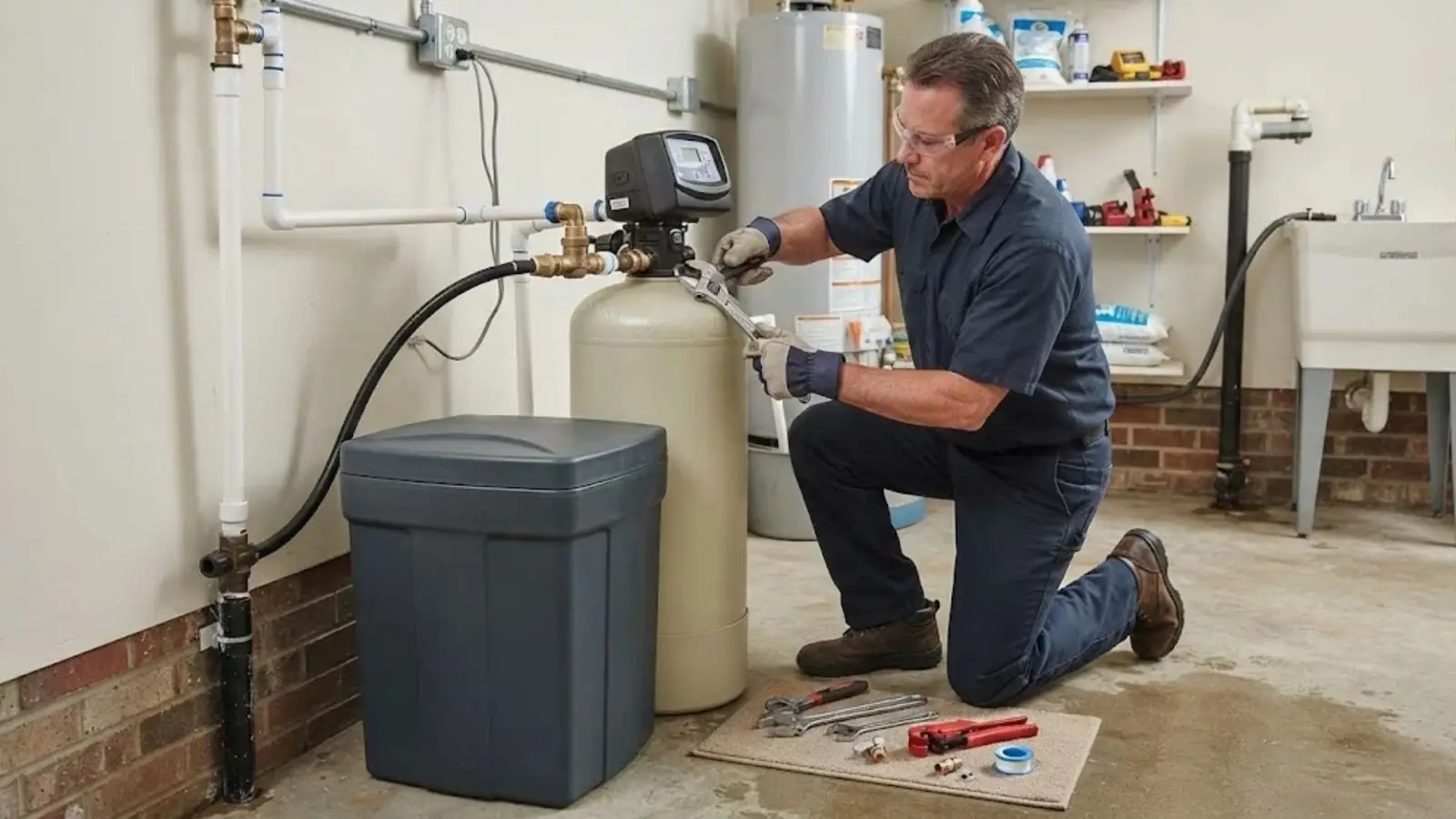
- The unit usually goes on the main line after the meter and shutoffs.
- A drain nearby is needed for regeneration water.
- An outlet is needed for the controller.
- Outdoor spigots are usually left on untreated water.
- A bypass valve lets you shut the unit off for service.
Related equipment and its effects are covered on our water softener and filtration page. If scale is damaging a heater, see water heater repair and tankless water heaters.
Running costs
Salt, water for regeneration and a small amount of electricity make up the running costs. Check the salt level every few weeks. If a unit uses far more salt than expected, a setting may be wrong. Many people find that fewer scale problems on appliances offset the cost, though that depends on the house.
We serve Westlake and nearby towns, including the area on our Rocky River page.
A simple comparison method
When you collect quotes, put them side by side with the same columns: unit type, capacity, what is included, plumbing work, warranty and who services it. A table makes it obvious when one quote leaves out the bypass valve or the drain connection.
Ask each company what they would do if the unit failed. A softener is a long-term piece of equipment, and a company that stands behind its work is worth more than a small saving at the start.
When not to buy a softener
If your own test shows low hardness, or the only complaint is taste, a softener is the wrong tool. Renters and people who plan to move soon may also decide against one. A good seller tells you when you do not need it.
Regeneration, salt and your water bill
During regeneration a softener flushes the resin with brine and rinses it, using some water and sending it to the drain. Most units regenerate at night on a schedule or on demand based on use. Ask whether the unit is demand-initiated, because those use less salt and water than timer-based units. Choose a unit with a clear display, so you can see the salt level and the settings.
Wondering what a softener would involve in your house? Call and ask about a survey.
Call (440) 468-0237Sources
Hardness and pH figures are from Cleveland Water's published 2025 report. The water bill link is from the City of Westlake website.
Questions homeowners ask
Cleveland Water reports moderately hard water. Whether you need a softener depends on your own tap and what bothers you, such as scale on fixtures or appliance wear. Test first.
No. A softener addresses hardness. Chlorine taste and odor are handled by a carbon filter.
Softened water has a small amount of added sodium or potassium, depending on the unit. People on low-sodium diets should ask their doctor.
Usually, if there is a drain, an outlet and room. We check the layout before quoting.